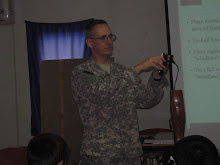
I have been home for a few days now. Tricia and the kids met me at the airport around midnight. It was a joyous reunion that was just a little overdue. Amazingly the kids went to school and continued their activities the next day. There was a nice banner on display in the house welcoming me back home.
Our trip to home was even more circuitous as time went by. Due to a heavy snowstorm in Baltimore, our transatlantic flight diverted to JFK airport in New York. We had a night in a hotel nearby and completed our journey to Baltimore the next day. Eleven hours after that and two additional flights later I landed at the nearest airport to our home. I was struck time and time again at how many people would stop and go out of their way to thank us for our service in the airport. It was a humbling experience.
Now that I am home and have started the process of packing away my gear and reintegrating with normal society I have had a little time to reflect on this long journey. I have learned a great many things during this past year. Travel always allows for that. Ours is an incredibly blessed country with a sound government and incredible natural resources. Afghanistan is a country plagued by decades of war with few natural resources other than the hard work of its very poor population. It is altogether right that we along with our Coalition partners do all that we can to allow the new government of Afghanistan to succeed, for the betterment of the people of Afghanistan. I am satisfied with the small but measurable accomplishments I have been a part of in Afghanistan. I hope that the people of Afghanistan will be better off in the long run for my efforts there.
I have also learned a great deal of personal things. In many ways my seven months in Afghanistan was like a seven month self improvement retreat. I was able to exercise regularly. Through study and worship I have attained a closer walk with God. I was able to learn some Dari, customs, and another different perspective of the world. Although time and distance are significant challenges, I think the last year has actually strengthened the bonds and commitment of several of my important relationships. The time I spent deployed also allowed me to firmly establish my priorities in life. Priorities I intend to not only list, but live from this point onwards.
With that in mind, this will be my last blog entry for this journey. Originally this enterprise was established as an effective way to reach and inform my family, friends, and co-workers en masse. With the outpouring of feedback and dialogue from those of you who have written emails, sent letters, packages, and provided support to me and my dear family it has transcended beyond the original intent of this project. Thank you so much for your support and dedication during this trying year.
I have enjoyed writing these entries over the past year. Truth be told, it was very therapeutic at times. I certainly learned more about specific aspects of Afghanistan with my limited research into various topics. Each time I sat at the MWR computers at Camp Spann it was almost like writing a timed short story, since we are limited to 30 minutes of time per session. It also gave me a sense of the passage of time and another scheduled task to perform which kept me sane. Nonetheless, it is time for this forum to be retired so that I can invest my time into the priorities to which I am dedicated.
While it is entirely possible that there may be another adventure to report in the coming years, since I do still wear the uniform of our country, I bid you farewell and thank you for travelling with me.
Wednesday, February 3, 2010


Friday, January 29, 2010
The Odyssey continues


It took Odysseus 10 years to find his way home after the end of the Trojan War.
It took me about 4 weeks of steaming home on a very old Naval vessel (LPD-1) to get home from the Desert Shield/Storm.
I have to keep these time frames in perspective, since I am still trying to make my way homeward. I left Camp Spann on the 5th of January. After languishing 2 weeks in Bagram and have 4 flights cancelled or held up to leave Kuwait I have a new goal. My new goal is to be out of Kuwait before the 1st of February. I think this is a realistic goal since otherwise we will be entitled to another tax-free month.
The list of policies and excuses which have kept us here is lengthy and would be even more humorous if I were not experiencing them: A broken plane, a plane iced in, a warning light, a new plane, a tired crew. In fact some are so absurd I may even use the quote I have heard so often during this deployment "You can't make this stuff up"
It would be more tolerable if we had access to our luggage. We cleared customs with our checked luggage on attempt #1 and it has been sequestered since that time. It is has been a challenge to live out of an overnight bag for 4 nights. I would have enjoyed spending more time in the gym to process and exercise my plight. But, the gym will not let anyone use the equipment in boots. I tried the elliptical in socks, but got blisters.
I have tried to look for the silver linings. Anything worth having is worth waiting for. Since we have to strip our linen every time we 'leave' I have experienced the cleanest linen of my deployment here. And my most recent- they must be keeping us up all night so that we will adjust to the time change better.
With luck I will be home in a few days.
Of course I keep remembering one definition of insanity- Repeating the same action over and over again in hopes of a different outcome.
Sunday, January 24, 2010
WTP
I am currently going through the Navy Warrior Transition Program. It is a three day program designed to ease the transition from being an IA with an Army mission back to home and the Navy. So far we have cleaned and returned our weapons, dumped 3 bags worth of field gear, and gone through the reintegration and stress debreif workshop. There has been plenty of down time thankfully. I have been able to place calls home and email regularly. The staff has been very attentive. We were given a "welcome back to the Navy" standing ovation cheer by the staff as we came in to return our gear. WTP is a good program. Just because I spent two weeks at Bagram waiting for a spot here, I would ask them to be more flexible with the number of personnel they accept at one time. Heaven knows the rest of the military is proving to be flexible in these difficult times.
They have a nice gym here, and I must say that the food here is really good. I spent part of today packing and repacking the remainder of the stuff I have here. Hopefully I can smush it down to one seabag and a carry on. I still have to do some heath screening and then we can start the travel portion of this program. That will be my favorite by far. I so look forward to being home.
They have a nice gym here, and I must say that the food here is really good. I spent part of today packing and repacking the remainder of the stuff I have here. Hopefully I can smush it down to one seabag and a carry on. I still have to do some heath screening and then we can start the travel portion of this program. That will be my favorite by far. I so look forward to being home.
Thursday, January 21, 2010
A new word for Webster's
Elvis has left the country. Yes I am now in Kuwait. After a hectic 30 hours of flights, convoys, waiting, loading and unloading of baggage I am at Camp Arifjan awaiting the official start of my Warrior Transition Program class. During this time I will do my final out processing and turn in all of the vast amounts of gear the Army lent me for this deployment. In fact, last night after a gruelling sleepless day and night our section had final weapons cleaning and turn-in. I feel liberated this morning without having to haul around my weapon(s) and ammunition, but I also wonder how many times I will look for it, or will put on my holster automatically. Today is a slow day, then tomorrow we start to turn in the other gear, go to some counselling workshops and prepare to depart in the coming days.
I continue to reflect on my experiences in Afghanistan, and after talking to many others who worked primarily in Kabul I have decided a new word needs to be added to the lexicon:


Kabulcentric- Policy or instructions that eminate from the capital city with primary regard for how these policies work in the capital or the 10 miles outside of Kabul, but apply to all of Afghanistan.
We have in our own country from time to time, a similiar situation with our Capital of Washington, D.C. Thankfully in our democratic republic the voice of the people is heard regularly. This is not the case in Afghanistan. Policies or plans which may work well in the urban chaos of Kabul may not translate well to the rest of Afghanistan. In most cases it does not work at all. I have seen time and again edicts from Kabul which do not pass the common sense or sniff test of those of us who have spent more than one week outside of the confines of the capital.
 Capital of Washington, D.C. Thankfully in our democratic republic the voice of the people is heard regularly. This is not the case in Afghanistan. Policies or plans which may work well in the urban chaos of Kabul may not translate well to the rest of Afghanistan. In most cases it does not work at all. I have seen time and again edicts from Kabul which do not pass the common sense or sniff test of those of us who have spent more than one week outside of the confines of the capital.
Part of this is due to ignorance. Please do not confuse this with arrongance, but ignorance as in downright lack of understanding of the challenges of the country. Very few Afghan officials or senior leaders tour the country. If they do, they are only directly taken to show pieces of success (dog and pony shows). So out of lack of understanding, policies are made based on the information at hand, what can be seen within the capital. There are video or phone conferences of the Afghan systems, but I have seen very few Afghans who would be forthright or foolish enough to admit a problem to their superiors in this way. So the leaders in Kabul are led to believe all is well in the rest of the country and anything is possible.
So I think that Kabulcentrism can be overcome, but it will require the officials in the government of Afghanistan to take the time to get out and see not only the successes or what they want to see, but ask the hard questions and get information on the realities of this diversified country.
Tuesday, January 19, 2010
Farewell Afghanistan

This should be my last post from Afghanistan. I am relieved to be departing from Bagram. In a few hours I will be on my way to the next stop on my long journey home. Once I arrive at my next stop I will spend several days returning all my issued gear and preparing for the next leg of the journey.

I intend to be more reflective on my next post, as time allows.
Sunday, January 17, 2010
Afghan food
I am still here at Bagram. Thankfully my L&L(Languishing and Loitering) here will be over in only a few short days. Then on to the next stop along the trip home.
As indicated in a previous post, today I will go over my experiences with Afghan foods.
نان
Naan is the most basic of these foods. In Dari the word can be used as the generic term for food. When talking about bread however, most Afghans use the term "Naan e Khushk" which translates to dry bread. Afghan naan is thicker than its Indian cousin you may have seen in restaurants. It is the staple with and by which an Afghan meal is eaten. In a traditional Afghan meal the food is eaten with the bare hands or pinched between a small piece of naan. I really enjoy the naan I have had here. Most naan I have seen or eaten in Afghanistan has a circular imprint like it was pressed between two hub cabs.
پلو
Palau is a small island country in the Pacific Ocean, but in the context of Afghan food it is something entirely different. Spiced rice with bits of almonds, raisins, occasionally carrots or meat is palau. The Afghan people eat palau almost as much as they eat naan. When not using naan e khushk to eat palau it is picked up with 2nd, 3rd, and 4th fingers in a trough like configuration. The thumb is then used as a piston to drive the palau into your mouth.
کباب
Kebab is another main food group. It is prepared on metal skewers. Sometimes it is all meat(goat, beef, or sheep) and other times I have seen large pieces of fat placed between the pieces of meat. I ate the fat a few times when offered a skewer of kebab this way until I observed my interpreter pull off the fat and set it to the side. If only I had known earlier I could have done the same without offending anyone! All the kebab I have ingested has been well cooked and tasty. You can either pull the meat off the skewer with your hands or with some naan.
As with most things, salad is different here. There are most of the same basic ingredients: leafy plants, carrots, onions and cucumbers. The main difference is the preparation. Most salads here are minced to the point that they may even appear to be pre-chewed. Generally it is served with oil and/or vinegar already mixed in.
That covers the major food groups, but what about snack foods? Any meeting with an Afghan will involve at least a little snack food and chai. The main snack foods I have seen are dried corn kernels, almonds whole in the shell, raisins, and small dried noodles similar to dried lo mein noodles found in a can in most US grocery stores. To be polite you must at least try some of the snacks offered.
Then there is the chai. Chai is tea. There are both green tea and black tea versions I have sipped in Afghanistan. It is usually boiling hot when served, so taking your time to let it cool and sip as you converse is the best option. It is most fortunate that it is served so hot, since the cups in my experience are rarely washed. You may find bits of leaves or twigs in your tea, which is considered normal as well. Overall it is warm, refreshing and a welcome beverage in Afghanistan.
I have really enjoyed the Afghan food I have experienced and despite all the bad publicity about illness. I have never had any GI problems due to Afghan food. In fact it is possible I may be able to have an Americanized version of it when I get home, assuming I can find some extra hubcaps.
As indicated in a previous post, today I will go over my experiences with Afghan foods.
نان
Naan is the most basic of these foods. In Dari the word can be used as the generic term for food.
 When talking about bread however, most Afghans use the term "Naan e Khushk" which translates to dry bread. Afghan naan is thicker than its Indian cousin you may have seen in restaurants. It is the staple with and by which an Afghan meal is eaten. In a traditional Afghan meal the food is eaten with the bare hands or pinched between a small piece of naan. I really enjoy the naan I have had here. Most naan I have seen or eaten in Afghanistan has a circular imprint like it was pressed between two hub cabs.
پلو
Palau is a small island country in the Pacific Ocean, but in the context of Afghan food it is something entirely different. Spiced rice with bits of almonds, raisins, occasionally carrots or meat is palau. The Afghan people eat palau almost as much as they eat naan. When not using naan e khushk to eat palau it is picked up with 2nd, 3rd, and 4th fingers in a trough like configuration. The thumb is then used as a piston to drive the palau into your mouth.
کباب
Kebab is another main food group. It is prepared on metal skewers.
 Sometimes it is all meat(goat, beef, or sheep) and other times I have seen large pieces of fat placed between the pieces of meat. I ate the fat a few times when offered a skewer of kebab this way until I observed my interpreter pull off the fat and set it to the side. If only I had known earlier I could have done the same without offending anyone! All the kebab I have ingested has been well cooked and tasty. You can either pull the meat off the skewer with your hands or with some naan.
As with most things, salad is different here. There are most of the same basic ingredients: leafy plants, carrots, onions and cucumbers. The main difference is the preparation. Most salads here are minced to the point that they may even appear to be pre-chewed. Generally it is served with oil and/or vinegar already mixed in.
Meat or gusht can also be served in a gravy sauce. The color is almost always brown, of course. It is good and goes well over the palau, or along side. The naan dips nicely into the gravy as well.
That covers the major food groups, but what about snack foods? Any meeting with an Afghan will involve at least a little snack food and chai. The main snack foods I have seen are dried corn kernels, almonds whole in the shell, raisins, and small dried noodles similar to dried lo mein noodles found in a can in most US grocery stores. To be polite you must at least try some of the snacks offered.
Then there is the chai. Chai is tea. There are both green tea and black tea versions I have sipped in Afghanistan. It is usually boiling hot when served, so taking your time to let it cool and sip as you converse is the best option. It is most fortunate that it is served so hot, since the cups in my experience are rarely washed. You may find bits of leaves or twigs in your tea, which is considered normal as well. Overall it is warm, refreshing and a welcome beverage in Afghanistan.
I have really enjoyed the Afghan food I have experienced and despite all the bad publicity about illness. I have never had any GI problems due to Afghan food. In fact it is possible I may be able to have an Americanized version of it when I get home, assuming I can find some extra hubcaps.
Friday, January 15, 2010
Dust

Afghanistan is a land of dust. It is the universal thing which seems to be a common ground, so to speak, for this entire country. Usually people think of sand in this part of the world, but I have seen very little real sand. This soil is very different than sand. Sand has a larger particle size and is therefore heavier. It takes a significant amount of wind energy to suspend sand in the air. That is not the case with the dust here. A light breeze is all that it takes to make a lasting cloud of obscuring dust. The light fine loam that passes for topsoil here covers the surface of everything in short order. You can literally clean floors every day and get a good yield of dust each time. As I have passed by vendors of bread, fruits and butchers shops I can't help but wonder how much dirt is on the surface of anything exposed to the air, especially along a busy road. I am guessing it makes up a significant portion of the dietary intake of your average Afghan. Here at Bagram there is much more dust than I am used to at Camp Spann. I am sure the constant traffic of helos, jets, and heavy equipment contribute greatly to the cloud of dust which is constantly in the air here. If not for the clouds of dust (ghobar in dari) Bagram could be a beautiful place with some picturesque snow covered mountains in the distance. But no amount of effort by any force will control the dust in this arid land. It is just another part of the character of this country.
Another dari dust word is Khaag bad, or dust storm (when they hit they can come in fast and give an eerie lighting much like an eclipse.)
I am sure that from now on Afghanistan will come to mind when I hear the ancient phrase 'dust to dust'.
Wednesday, January 13, 2010
Coalition Cuisine

I still have a little more time on my hands here. Time to reflect on many things I experienced here in Afghanistan. Today's post is dedicated to food. Let's take a look at food around the Area of Operations (AO). I am limiting this entry to Coalition food and may comment on Afghan food another time.
The food of Camp Spann is provided by Kellog, B rown and Root (KBR). The food is served in a line cafeteria style. Generally it is American style heavy on the fried foods. The service at Spann was always friendly and courteous. KBR also runs the chow halls down here at Bagram and all other US run bases. The food is always plentiful and has ice cream.
 rown and Root (KBR). The food is served in a line cafeteria style. Generally it is American style heavy on the fried foods. The service at Spann was always friendly and courteous. KBR also runs the chow halls down here at Bagram and all other US run bases. The food is always plentiful and has ice cream.
Next is the contractor Supreme. Supreme is found in most large Coalition base chow halls including those on German and Italian bases. The food is decidedly European in flavor and offerings. Breakfast is usually very sparse. There are cold cuts aplenty and very good cheeses. I also think Supreme provides food at most of the State Department bases at least in the north. When there are Gurkas providing security, the Indian food is excellent at these small State Department posts.
I have also eaten at a real German chow hall. The active duty staff wear these wild checkered pants. The food is similar to that found in Supreme kitchens, but with very friendly staff. Most entrees have some form of pig in them. One night of the week they shut down the chow hall completely and serve heated German style MRE's. Most folks go to eat at the grill in the German PX on that day.
Finally to my favorite chow hall in all of Afghanistan. The Norwegian chow hall at Camp Marmal. I believe the food is catered by Sodexo. The chow hall is located in a tent despite the number of years it has been there. Although it is in a tent, it has a friendly ambiance and is a great place to eat. They do have hours posted for those of us who are not Norwegian to eat, which is only right. They greet you with incredible grace as you enter. The food is served on real plates and silverware and served buffet style. My last meal there was memorable: paella, glazed chicken served on a bed of couscous with raisins and slivered almonds. The soup was leek and potato. Altogether it is the best Coalition dining experience I have had in country.
Of course we all know the best food is home cooked. I am looking forward to eating there very much.
Sunday, January 10, 2010
Still Stuck at BAF
I am still here at Bagram. All things considered it is better than the last time I was here. I am in a better tent. I know where all the chow halls and services are. I found the cleanest bathrooms in our area.
There are numerous challenges, but the most problematic is just being here. The Navy has mandated a 3 day Warrior Transition Program at Kuwait. Too bad I will have to wait 2 weeks in order to get to this 3 day program. It is overbooked for the entire month. At this point I am just ready to return and start to readust to life back home. One thing that is truly amazing are the lines. Lines for the phones, computers, food, beverages, toilets, ATM machines, and anything else you can think of. Maybe this is a final dose of deployment just to make me even more appreciative of life at home. I doubt that is possible though.
There are numerous challenges, but the most problematic is just being here. The Navy has mandated a 3 day Warrior Transition Program at Kuwait. Too bad I will have to wait 2 weeks in order to get to this 3 day program. It is overbooked for the entire month. At this point I am just ready to return and start to readust to life back home. One thing that is truly amazing are the lines. Lines for the phones, computers, food, beverages, toilets, ATM machines, and anything else you can think of. Maybe this is a final dose of deployment just to make me even more appreciative of life at home. I doubt that is possible though.
Friday, January 8, 2010
Sustainability
I made extremely good time from Mazar-e-Sharif to Bagram, but I will be stuck here for quite some time. There were still a few sailors from the returning hospital mentor team I served with on Spann here when I arrived. They left two weeks before I did. So I have plenty more time to exercise at a higher elevation and reflect .
One of the things I am considering is Sustainability. In particular how will Afghanistan be able to sustain what has been started. In general the best approach to most issues or problems is to find a low cost-high return solution(IE not always the way we do things in the US). There is much effort being placed on Afghan National Security Forces (ANSF) force generation and infrastructure development. What I have not seen or heard about is economic development or income programs for the country of Afghanistan.
 .
One of the things I am considering is Sustainability. In particular how will Afghanistan be able to sustain what has been started. In general the best approach to most issues or problems is to find a low cost-high return solution(IE not always the way we do things in the US). There is much effort being placed on Afghan National Security Forces (ANSF) force generation and infrastructure development. What I have not seen or heard about is economic development or income programs for the country of Afghanistan.

This is concerning since whatever progress, programs, or forces we build and equip here will need to be funded for the long term. Who is going to pay? I fear it will be American and Coalition taxpayers. There are resources here in the country such as agriculture, mines, and textiles. If these areas are not developed and appropriately taxed by the Afghan government I do not see how it will financially survive. There is no income tax here. There is no sales tax that I have witnessed. The only taxation I have heard about is on contractors. As an example if NATO funds a 5 million dollar project and awards the construction to a contractor, then the contractor must pay 20% of the price to the Afghan government. So out of the 5 million dollar project, 1 million goes directly to the Afghan government. If this is the only income generation other than direct grants from the US and other Coalition governments, the government of Afghanistan will indeed be trouble after our support dissipates.
 funds a 5 million dollar project and awards the construction to a contractor, then the contractor must pay 20% of the price to the Afghan government. So out of the 5 million dollar project, 1 million goes directly to the Afghan government. If this is the only income generation other than direct grants from the US and other Coalition governments, the government of Afghanistan will indeed be trouble after our support dissipates.
So while building cost effective solutions at all levels is important to improve the lives and services of the people of Afghanistan, a long term funding plan so that this country can afford all that is being built up is just as important.
 lives and services of the people of Afghanistan, a long term funding plan so that this country can afford all that is being built up is just as important.
Wednesday, January 6, 2010
Spann Nostalgia

It was on New Year's Day when I truly realized it is time to start heading home. While I am reassured that I have contributed in some small way to the progress of Afghanistan, it is difficult to leave with some projects half done. Luckily the military is a team sport. In this case a relay team sport. I have turned over all my projects and information to the new member of the team. I have passed the baton . There remains much more to be done for medical support of the police in this region, but I know the team will make tremendous progress this next year. I am ready to return home to my family, co-workers and patients.


So while I am thrilled with the prospect of going home, I felt a certain amount of nostalgia as I walked around Camp Spann today. Some of these memories are pleasant and will be easily remember. I ate my last dinner in the chow hall. I wrote my last blog entry in the MWR computer room. I made my last stop in the Chapel to say goodbye. The view of the mountains in the distance is alway relaxing as well.
 prospect of going home, I felt a certain amount of nostalgia as I walked around Camp Spann today. Some of these memories are pleasant and will be easily remember. I ate my last dinner in the chow hall. I wrote my last blog entry in the MWR computer room. I made my last stop in the Chapel to say goodbye. The view of the mountains in the distance is alway relaxing as well.
There is also another group of memories that I might choose to forget. My feet will not miss the huge rocks that make up the gravel  all around camp. Be thankful I only am displaying a picture of the port-a-potty from the outside. They most certainly will not be missed.


So I today I present to you a collage of the more mundane aspects of life on Camp Spann.
The doves are still nesting every night at the bath house near my hut. 
Sunday, January 3, 2010
Afghan Doctor

Doctor can be a very deceptive title in Afghanistan. When most people in the US speak of a doctor, they are speaking about a Medical professional with a doctorate degree in Medicine who has a license to practice medicine. Here, as with many things, the lines of differentiation blur to the point of becoming a continuum of gray space. I have been introduced to many Afghans who refer to themselves as a doctor. In truth most are acting in the capacity of a physician, but they usually do not have training in medicine. The term Doctor is used for both Medics and Medical Doctors(MD). It can be very confusing for all involved including the patients.
To be fair, the Afghan Medical Education system has had some hard knocks in the past few decades. Under the Taliban learning of most types was frowned upon and women were strictly prohibited from studying medicine. Now there are at least 4 internationally recognized medical schools in Afghanistan and several others that are not recongnized. Most schools subscribe to the European model 7 year training program. The bachelors and doctorate degree are combined into one program. Overall the system is lecture heavy and light on interactions with actual patients. Out of the 7 years, only one is spent in hospitals and clinics observing or assisting with patient care. This system produces doctors who know the lecture type details and pathophysiology of disease, but may lack the experience in practical application to patients. The most prestigious and well respected institution of medicine is Kabul Medical University. With as many as 400 students a year going through clinic rotations at Kabul hospitals, it is difficult to imagine they get the same level of involvment in patient care that we experience in the US as students.
Specialty training is also very different in Afghanistan. Specialty training is more like an apprenticeship than a program of structured learning. There is no set time to complete the training. Doctors work under a specialist (surgeon, internal medicine, anesthesiologist) until their preceptor determines they know enough to be on their own. There is no board certification testing or validation to a governing body. While this seems to work well for some specialties (surgeons in particular are widely accepted as being very well skilled) others not so much. For instance, I have seen ENT specialists who do not seem to know how to use an otoscope to check the ear canal and tympanic membranes. While this apprenticeship style of post graduate training is very different for us to accept, it works most of the time for the Afghan people. What is more it is the only system they have for right now.
Are you confused yet? If so I have adequately explained what is meant by the term Afghan doctor.
Thursday, December 31, 2009
Combined ANP/US Range and Golf
 Weeks ago when we were talking and having chai with our ANP counterparts the topic of weapons came up. Our counterparts relayed to us that they had not been trained on their pistols and were not very comfortable with their use. Since they do carry these weapons and rely on them for their personal safety, we decided to arrange some time together on the range to practice. After a basic range safety lecture through my interpreter, we began.
I was expecting their pistols to be old WWII era soviet style weapons. I was quite suprised to
 find that they carry new Smith and Wesson 9mm pistols. Their pistols did not have a safety, but were light weight and handled well. One of the weapons misfired a few times, but I suspect that more oil was needed. They did fine and improved with only a little practice. We also let them shoot our pistols, which are much older in design comparitively. We ended the shooting with a familiarization fire of the M-4 which was orderly as well.
After the shooting Steve took out the golf clubs. All of the Afghans
 universally said it was much harder to hit a golf ball than watching TV might suggest. I was worried that some of the clubs would be literally broken in half due to the hatchet like swing of some of the new golf initiates. There were quite a few laughs and a good time was had by all. It was a good safe time. I suspect this was the last mentoring type activity I will perform in this country. There is a new member of the team here now, so very soon it will be time for me to move on.


Wednesday, December 30, 2009
New Clinic Open
 For those of you who have been following all along you may remember my post from 17 August. In that post I showed you an ANP clinic which was still under construction. Well, yesterday we visited the same clinic and it is now open and operational. Our Afghan counterparts were very creative in furnishing and outfitting the clinic until a package of goods arrives from Kabul to fully equip and stock it.

There are still a few minor issues to be resolved, but this clinic is a significant step up in facilities for them. It is new. It has running water. It has a continuous power source. It has heat and air conditioning. The staff who will be running the clinic were kind enough to pose outside of it. I am almost shocked that it only took four months to get this clinic completed and operational. While this
 may seem like slow progress by our standards, it is light speed for Afghanistan.
Time has a different quality here. In this land, Alexander the Great came into town 'sometime yesterday'. There is a common saying here; "You may have watches, but we have Time". Many Americans will interpret this as laziness, but it is more a cultural acceptance of the limits of time. I am just glad that I could actually see one more milestone achieved during my time here.
This was probably my last mission "Outside the Wire". My replacement is here and the team will have to press forward with our many other projects without me.
Monday, December 28, 2009
Rumi------ Jalāl ad-Dīn Muḥammad Balkhī جلال الدین محمد بلخى

Local boy becomes world class poet.
That would be the headlines if there were any when Rumi (1300's) was alive. He was born only a few miles away from where I sit right now and is still revered as one of the most eloquent poets of all time on the subject of Love in mystical ways. His family fled the Mongol hordes as they invaded this area and fled west. It was in the Sultanate of Rum in modern day Turkey that he came to pre-eminence as a spiritual philosopher and most notably as a poet. This gave him his "nickname" of Rumi, although Afghans still refer to him as Balkhi- coming from Balkh.
Translations of his Farsi/Dari poems still ring our ears today. He gives such a different perspective on issues. His poetry is unique.
Just a few excerpts translated:
Looking at my life
I see that only Love
Has been my soul’s companion
From deep inside
My soul cries out:
Do not wait, surrender
For the sake of Love.
You know what love is?
It is all kindness, generosity.
Disharmony prevails when
You confuse lust with love, while
The distance between the two
Is endless.
I read that Rumi was the last documented person to have people of five different faiths carry his funeral bier. He even has some poems about Jesus. The Mawlawī Sufi order or order of Whirling Dervishes was founded in 1273 by Rumi's followers after his death. His son Sultan Walad was installed as grand master of the order. The leadership of the order has been kept within Rumi's family in Konya uninterruptedly since that time.
I encourage you to investigate some of Rumi's works. You may be suprised what Afghanistan has contributed to the culture of the world.
Saturday, December 26, 2009
Chistmas Day

Christmas was a wonderful but busy day. We had three services within 24 hours, with lots of good singing. I had the opportunity to watch a flock of goats for several hours on guard duty. Finally we had a good ole time at the First Annual 5k Jingle Bell run around Camp Spann. If there was a category I am sure I would have won 'Best hat made out of office supplies'. The meals were very good and ample as well. I had some good calls back to my family to find out how my gifts went over. It was quite a Birthday Celebration. I hope you had a fun and meaningful Christmas too.
And a Special Thank you to those who sent boxes, presents, decorations, or greetings. They were all much appreciated. Merry Christmas!
Monday, December 21, 2009
Shab e Yalda شب یلدا

In the western world we think of the 21st of December as the Winter solstice. The night of the 21st is the longest of the year for the northern hemisphere.
In Iranian and to some degree Afghan culture the night of the 21st of December is Shab-e Yalda شب یلدا .
It is an Iranian festival whose origins go all the way back to Babylonian and Zoroastrian religious rights. It has been adopted over time and is still celebrated as a winter feast, when families will sit up all night around a fire telling stories and eating melons, pomegranate, and nuts.
Because Shab-e Yalda is the longest and darkest night, it has come to symbolise many things in Persian poetry; separation from a loved one, loneliness and waiting. After Shab-e Yalda a transformation takes place - the waiting is over, light shines and goodness prevails.
Shab-e Yalda is also a very special day to someone very close to me. Someone I hope to see soon. And while it may not be fast enough, sometime after Shab-e Yalda the waiting will be over. Light and goodness will prevail.
Sunday, December 20, 2009
Freedom Chapel International Christmas Service

Tonight we had our International Christmas service. There were readings and songs in English, Croatian, and Norwegian. Sweden and Macedonia were also represented in the choirs as well. The service showed that we are all brothers and sisters in Christ regardless of the language we speak. For the closing song "Silent Night", we sang the first verse in English, then in Croatian, then in Norwegian. It was a festive time and well attended. I look forward to more Christmas Celebrations this week.
Tuesday, December 15, 2009
Leishmaniasis Part II

Some of you may remember my post from approximately 1 month ago. Well, Chad has finished his one month of almost daily injections into the site of his cutaneous leishmaniasis. You may be able to identify the leg and running shoes. His wound looks much better, although it still has some thickening of the skin (induration in medical jargon). At this point he will be observed for relapse or a need for further injections. I have heard that one or two soldiers out of the dozen affected by this disease recently had to be evacuated to Walter Reed for treatment of their leishmaniasis with IV medication. But the worst appears to be over for Chad.

It is the Christmas Season, even in Afghanistan. A few of us hardy and cheerful folk met last night to sing Christmas Carols at the entrance to the Chow Hall for about an hour. It was good a good time and actually a lot of fun. After practicing a while outside we got brave enough to go in and sing a few songs in each dining area. I am sure there will be a repeat performance for those of you who missed it. While Afghanistan may not be our home, for those with the desire, it can still be a place of fellowship and fun during this Holy Season.
Sunday, December 13, 2009
FOO-lishness
There are some issues or events that never even make it to a post. Others, like today's, I have to think about for a long time before posting since I endeavor to be positive about our role here. Today's issue still has the potential to be a rant instead of informative.
Basic Warfare 101 teaches us that armed conflict is just an extension of diplomacy. There is a published Army Field Manual that provides guidance on the use of money as a weapons system. Out of all the tools at our disposal to effect positive change in this country, money is the most effective.
There are several programs by which mentors can buy goods or services for their Afghan counterparts. One of these programs is the Field Ordering Officer or FOO program. Others include the Commanders Emergency Relief Program (CERP), PR&C projects, and many more lesser known acronyms. The only one we really heard about in mentor training was FOO. The obvious goal of mentoring is to coach the Afghans so they can successfully navigate their own logistics systems and ensure they are self sufficient. Sometimes, however, we cannot let them fail. Sometimes we need to spend money to ensure they can complete their mission of securing Afghanistan. Most people with experience would agree that logistical planning is not a strong suit for the Afghans. The FOO program exists to fill in the shortfalls in logistical planning so that the Afghans can continue their mission in a timely manner. It requires a two person US team to go through a short course, then be responsible and accountable for money signed over by the US Government. Above is a picture of my most recent draw of FOO money. It is a stack of bills that equals 1 million Afghani. The US equivalent is $20,000. It is a lot of money, and our team only spent a small fraction of it.
Unfortunately the accountants and contact clearance personnel in Kabul have essentially scuttled this program. What may have been a useful program to offset shortcomings in the Afghan military planning process is now useless. About two months into our time here a new team of accountants at Kabul took over and radically changed the rules of what could be bought and how it was justified. All purchases were questioned from that point onwards and items that were retrospectively considered unauthorized were billed to the team personally. The result is that teams are now fearful of spending any money to support the mission. We can either assume that the Afghans have totally figured out how to work their system in the past 4 months(very unlikely), or that the mission is suffering. What is more there are lots of hardworking American soldiers who are now being held financially responsible for purchases they thought were in good faith. I know of at least three teams in the northern area who are being held personally financially responsible for purchases which seem to fulfill the intent, if not the letter of the regulations.
One Army National Guard Lt is having to pay $900 dollars out of his own pocket to reimburse the government for 'unauthorized purchases'. He bought water for the Afghan National Army so that they could complete a field mission. Another Army National Guard soldier is being held responsible for $300. He used FOO money to contract some wiring for a refrigerated container for an ANA kitchen. We all know that soldiers fight better when they are fed spoiled food. Another team paid $180 for parts and wiring to fix washing machines that were broken at an Afghan army hospital (who knew that hospitals had to have clean linen?) Somehow it does not seem right that soldiers of conscience who were trying to directly impact and benefit the Afghan mission here should have to pay (literally) for their service.
On the other hand, for many years now I have always applied the 'Uncle Dale' Principle to spending the Government's money. My Uncle Dale, a proud taxpayer, was astounded one year to find that the Navy paid rent for us to live in a nice house in Italy while we were stationed there. Since that time I have always considered whether or not my Uncle Dale would approve spending that I might do on his behalf.
But lets also put this in larger perspective. How much has the US spent on me so far during this deployment? If you add up three months of training, cost of contract instructors, ammunition, fuel, my salary, food, housing, transportation, and additional deployment pays, it is a lot. I would guess that the US has spent about $500,000 just to get me trained and here. So why quibble about a paltry few hundred dollars spent directly on the mission? Besides, who can better decide what is necessary to accomplish the mission at hand: mentors who work with the Afghans daily, or accountants in Kabul? It almost appears that the HQ in Kabul seems intent on undermining this program and therefore our direct mentoring efforts. We are here to teach the Afghans how to think for themselves, plan ahead and succeed. How unfortunate it is that we seem to have learned from the Afghan(Russian old style centralized command) system, instead of them learning from us.
If the American people want to know why we are not making more progress with the Afghan National Security Forces, they need look no further than the FOO program and how it has been hamstrung.
Basic Warfare 101 teaches us that armed conflict is just an extension of diplomacy. There is a published Army Field Manual that provides guidance on the use of money as a weapons system. Out of all the tools at our disposal to effect positive change in this country, money is the most effective.
There are several programs by which mentors can buy goods or services for their Afghan counterparts. One of these programs is
 the Field Ordering Officer or FOO program. Others include the Commanders Emergency Relief Program (CERP), PR&C projects, and many more lesser known acronyms. The only one we really heard about in mentor training was FOO. The obvious goal of mentoring is to coach the Afghans so they can successfully navigate their own logistics systems and ensure they are self sufficient. Sometimes, however, we cannot let them fail. Sometimes we need to spend money to ensure they can complete their mission of securing Afghanistan. Most people with experience would agree that logistical planning is not a strong suit for the Afghans. The FOO program exists to fill in the shortfalls in logistical planning so that the Afghans can continue their mission in a timely manner. It requires a two person US team to go through a short course, then be responsible and accountable for money signed over by the US Government. Above is a picture of my most recent draw of FOO money. It is a stack of bills that equals 1 million Afghani. The US equivalent is $20,000. It is a lot of money, and our team only spent a small fraction of it.
Unfortunately the accountants and contact clearance personnel in Kabul have essentially scuttled this program. What may have been a useful program to offset shortcomings in the Afghan military planning process is now useless. About two months into our time here a new team of accountants at Kabul took over and radically changed the rules of what could be bought and how it was justified. All purchases were questioned from that point onwards and items that were retrospectively considered unauthorized were billed to the team personally. The result is that teams are now fearful of spending any money to support the mission. We can either assume that the Afghans have totally figured out how to work their system in the past 4 months(very unlikely), or that the mission is suffering. What is more there are lots of hardworking American soldiers who are now being held financially responsible for purchases they thought were in good faith. I know of at least three teams in the northern area who are being held personally financially responsible for purchases which seem to fulfill the intent, if not the letter of the regulations.
One Army National Guard Lt is having to pay $900 dollars out of his own pocket to reimburse the government for 'unauthorized purchases'. He bought water for the Afghan National Army so that they could complete a field mission. Another Army National Guard soldier is being held responsible for $300. He used FOO money to contract some wiring for a refrigerated container for an ANA kitchen. We all know that soldiers fight better when they are fed spoiled food. Another team paid $180 for parts and wiring to fix washing machines that were broken at an Afghan army hospital (who knew that hospitals had to have clean linen?) Somehow it does not seem right that soldiers of conscience who were trying to directly impact and benefit the Afghan mission here should have to pay (literally) for their service.
On the other hand, for many years now I have always applied the 'Uncle Dale' Principle to spending the Government's money. My Uncle Dale, a proud taxpayer, was astounded one year to find that the Navy paid rent for us to live in a nice house in Italy while we were stationed there. Since that time I have always considered whether or not my Uncle Dale would approve spending that I might do on his behalf.
But lets also put this in larger perspective. How much has the US spent on me so far during this deployment? If you add up three months of training, cost of contract instructors, ammunition, fuel, my salary, food, housing, transportation, and additional deployment pays, it is a lot. I would guess that the US has spent about $500,000 just to get me trained and here. So why quibble about a paltry few hundred dollars spent directly on the mission? Besides, who can better decide what is necessary to accomplish the mission at hand: mentors who work with the Afghans daily, or accountants in Kabul? It almost appears that the HQ in Kabul seems intent on undermining this program and therefore our direct mentoring efforts. We are here to teach the Afghans how to think for themselves, plan ahead and succeed. How unfortunate it is that we seem to have learned from the Afghan(Russian old style centralized command) system, instead of them learning from us.
If the American people want to know why we are not making more progress with the Afghan National Security Forces, they need look no further than the FOO program and how it has been hamstrung.
Subscribe to:
Posts (Atom)