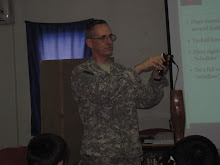
I have been home for a few days now. Tricia and the kids met me at the airport around midnight. It was a joyous reunion that was just a little overdue. Amazingly the kids went to school and continued their activities the next day. There was a nice banner on display in the house welcoming me back home.
Our trip to home was even more circuitous as time went by. Due to a heavy snowstorm in Baltimore, our transatlantic flight diverted to JFK airport in New York. We had a night in a hotel nearby and completed our journey to Baltimore the next day. Eleven hours after that and two additional flights later I landed at the nearest airport to our home. I was struck time and time again at how many people would stop and go out of their way to thank us for our service in the airport. It was a humbling experience.
Now that I am home and have started the process of packing away my gear and reintegrating with normal society I have had a little time to reflect on this long journey. I have learned a great many things during this past year. Travel always allows for that. Ours is an incredibly blessed country with a sound government and incredible natural resources. Afghanistan is a country plagued by decades of war with few natural resources other than the hard work of its very poor population. It is altogether right that we along with our Coalition partners do all that we can to allow the new government of Afghanistan to succeed, for the betterment of the people of Afghanistan. I am satisfied with the small but measurable accomplishments I have been a part of in Afghanistan. I hope that the people of Afghanistan will be better off in the long run for my efforts there.
I have also learned a great deal of personal things. In many ways my seven months in Afghanistan was like a seven month self improvement retreat. I was able to exercise regularly. Through study and worship I have attained a closer walk with God. I was able to learn some Dari, customs, and another different perspective of the world. Although time and distance are significant challenges, I think the last year has actually strengthened the bonds and commitment of several of my important relationships. The time I spent deployed also allowed me to firmly establish my priorities in life. Priorities I intend to not only list, but live from this point onwards.
With that in mind, this will be my last blog entry for this journey. Originally this enterprise was established as an effective way to reach and inform my family, friends, and co-workers en masse. With the outpouring of feedback and dialogue from those of you who have written emails, sent letters, packages, and provided support to me and my dear family it has transcended beyond the original intent of this project. Thank you so much for your support and dedication during this trying year.
I have enjoyed writing these entries over the past year. Truth be told, it was very therapeutic at times. I certainly learned more about specific aspects of Afghanistan with my limited research into various topics. Each time I sat at the MWR computers at Camp Spann it was almost like writing a timed short story, since we are limited to 30 minutes of time per session. It also gave me a sense of the passage of time and another scheduled task to perform which kept me sane. Nonetheless, it is time for this forum to be retired so that I can invest my time into the priorities to which I am dedicated.
While it is entirely possible that there may be another adventure to report in the coming years, since I do still wear the uniform of our country, I bid you farewell and thank you for travelling with me.
Wednesday, February 3, 2010


Friday, January 29, 2010
The Odyssey continues


It took Odysseus 10 years to find his way home after the end of the Trojan War.
It took me about 4 weeks of steaming home on a very old Naval vessel (LPD-1) to get home from the Desert Shield/Storm.
I have to keep these time frames in perspective, since I am still trying to make my way homeward. I left Camp Spann on the 5th of January. After languishing 2 weeks in Bagram and have 4 flights cancelled or held up to leave Kuwait I have a new goal. My new goal is to be out of Kuwait before the 1st of February. I think this is a realistic goal since otherwise we will be entitled to another tax-free month.
The list of policies and excuses which have kept us here is lengthy and would be even more humorous if I were not experiencing them: A broken plane, a plane iced in, a warning light, a new plane, a tired crew. In fact some are so absurd I may even use the quote I have heard so often during this deployment "You can't make this stuff up"
It would be more tolerable if we had access to our luggage. We cleared customs with our checked luggage on attempt #1 and it has been sequestered since that time. It is has been a challenge to live out of an overnight bag for 4 nights. I would have enjoyed spending more time in the gym to process and exercise my plight. But, the gym will not let anyone use the equipment in boots. I tried the elliptical in socks, but got blisters.
I have tried to look for the silver linings. Anything worth having is worth waiting for. Since we have to strip our linen every time we 'leave' I have experienced the cleanest linen of my deployment here. And my most recent- they must be keeping us up all night so that we will adjust to the time change better.
With luck I will be home in a few days.
Of course I keep remembering one definition of insanity- Repeating the same action over and over again in hopes of a different outcome.
Sunday, January 24, 2010
WTP
I am currently going through the Navy Warrior Transition Program. It is a three day program designed to ease the transition from being an IA with an Army mission back to home and the Navy. So far we have cleaned and returned our weapons, dumped 3 bags worth of field gear, and gone through the reintegration and stress debreif workshop. There has been plenty of down time thankfully. I have been able to place calls home and email regularly. The staff has been very attentive. We were given a "welcome back to the Navy" standing ovation cheer by the staff as we came in to return our gear. WTP is a good program. Just because I spent two weeks at Bagram waiting for a spot here, I would ask them to be more flexible with the number of personnel they accept at one time. Heaven knows the rest of the military is proving to be flexible in these difficult times.
They have a nice gym here, and I must say that the food here is really good. I spent part of today packing and repacking the remainder of the stuff I have here. Hopefully I can smush it down to one seabag and a carry on. I still have to do some heath screening and then we can start the travel portion of this program. That will be my favorite by far. I so look forward to being home.
They have a nice gym here, and I must say that the food here is really good. I spent part of today packing and repacking the remainder of the stuff I have here. Hopefully I can smush it down to one seabag and a carry on. I still have to do some heath screening and then we can start the travel portion of this program. That will be my favorite by far. I so look forward to being home.
Thursday, January 21, 2010
A new word for Webster's
Elvis has left the country. Yes I am now in Kuwait. After a hectic 30 hours of flights, convoys, waiting, loading and unloading of baggage I am at Camp Arifjan awaiting the official start of my Warrior Transition Program class. During this time I will do my final out processing and turn in all of the vast amounts of gear the Army lent me for this deployment. In fact, last night after a gruelling sleepless day and night our section had final weapons cleaning and turn-in. I feel liberated this morning without having to haul around my weapon(s) and ammunition, but I also wonder how many times I will look for it, or will put on my holster automatically. Today is a slow day, then tomorrow we start to turn in the other gear, go to some counselling workshops and prepare to depart in the coming days.
I continue to reflect on my experiences in Afghanistan, and after talking to many others who worked primarily in Kabul I have decided a new word needs to be added to the lexicon:
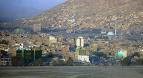

Kabulcentric- Policy or instructions that eminate from the capital city with primary regard for how these policies work in the capital or the 10 miles outside of Kabul, but apply to all of Afghanistan.
We have in our own country from time to time, a similiar situation with our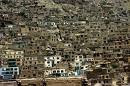 Capital of Washington, D.C. Thankfully in our democratic republic the voice of the people is heard regularly. This is not the case in Afghanistan. Policies or plans which may work well in the urban chaos of Kabul may not translate well to the rest of Afghanistan. In most cases it does not work at all. I have seen time and again edicts from Kabul which do not pass the common sense or sniff test of those of us who have spent more than one week outside of the confines of the capital.
 Capital of Washington, D.C. Thankfully in our democratic republic the voice of the people is heard regularly. This is not the case in Afghanistan. Policies or plans which may work well in the urban chaos of Kabul may not translate well to the rest of Afghanistan. In most cases it does not work at all. I have seen time and again edicts from Kabul which do not pass the common sense or sniff test of those of us who have spent more than one week outside of the confines of the capital.
 Part of this is due to ignorance. Please do not confuse this with arrongance, but ignorance as in downright lack of understanding of the challenges of the country. Very few Afghan officials or senior leaders tour the country. If they do, they are only directly taken to show pieces of success (dog and pony shows). So out of lack of understanding, policies are made based on the information at hand, what can be seen within the capital. There are video or phone conferences of the Afghan systems, but I have seen very few Afghans who would be forthright or foolish enough to admit a problem to their superiors in this way. So the leaders in Kabul are led to believe all is well in the rest of the country and anything is possible.
So I think that Kabulcentrism can be overcome, but it will require the officials in the government of Afghanistan to take the time to get out and see not only the successes or what they want to see, but ask the hard questions and get information on the realities of this diversified country.
Tuesday, January 19, 2010
Farewell Afghanistan

This should be my last post from Afghanistan. I am relieved to be departing from Bagram. In a few hours I will be on my way to the next stop on my long journey home. Once I arrive at my next stop I will spend several days returning all my issued gear and preparing for the next leg of the journey.

I intend to be more reflective on my next post, as time allows.
Sunday, January 17, 2010
Afghan food
I am still here at Bagram. Thankfully my L&L(Languishing and Loitering) here will be over in only a few short days. Then on to the next stop along the trip home.
As indicated in a previous post, today I will go over my experiences with Afghan foods.
نان
Naan is the most basic of these foods. In Dari the word can be used as the generic term for food. When talking about bread however, most Afghans use the term "Naan e Khushk" which translates to dry bread. Afghan naan is thicker than its Indian cousin you may have seen in restaurants. It is the staple with and by which an Afghan meal is eaten. In a traditional Afghan meal the food is eaten with the bare hands or pinched between a small piece of naan. I really enjoy the naan I have had here. Most naan I have seen or eaten in Afghanistan has a circular imprint like it was pressed between two hub cabs.
پلو
Palau is a small island country in the Pacific Ocean, but in the context of Afghan food it is something entirely different. Spiced rice with bits of almonds, raisins, occasionally carrots or meat is palau. The Afghan people eat palau almost as much as they eat naan. When not using naan e khushk to eat palau it is picked up with 2nd, 3rd, and 4th fingers in a trough like configuration. The thumb is then used as a piston to drive the palau into your mouth.
کباب
Kebab is another main food group. It is prepared on metal skewers.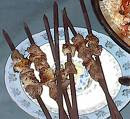 Sometimes it is all meat(goat, beef, or sheep) and other times I have seen large pieces of fat placed between the pieces of meat. I ate the fat a few times when offered a skewer of kebab this way until I observed my interpreter pull off the fat and set it to the side. If only I had known earlier I could have done the same without offending anyone! All the kebab I have ingested has been well cooked and tasty. You can either pull the meat off the skewer with your hands or with some naan.
As with most things, salad is different here. There are most of the same basic ingredients: leafy plants, carrots, onions and cucumbers. The main difference is the preparation. Most salads here are minced to the point that they may even appear to be pre-chewed. Generally it is served with oil and/or vinegar already mixed in.
That covers the major food groups, but what about snack foods? Any meeting with an Afghan will involve at least a little snack food and chai. The main snack foods I have seen are dried corn kernels, almonds whole in the shell, raisins, and small dried noodles similar to dried lo mein noodles found in a can in most US grocery stores. To be polite you must at least try some of the snacks offered.
Then there is the chai. Chai is tea. There are both green tea and black tea versions I have sipped in Afghanistan. It is usually boiling hot when served, so taking your time to let it cool and sip as you converse is the best option. It is most fortunate that it is served so hot, since the cups in my experience are rarely washed. You may find bits of leaves or twigs in your tea, which is considered normal as well. Overall it is warm, refreshing and a welcome beverage in Afghanistan.
I have really enjoyed the Afghan food I have experienced and despite all the bad publicity about illness. I have never had any GI problems due to Afghan food. In fact it is possible I may be able to have an Americanized version of it when I get home, assuming I can find some extra hubcaps.
As indicated in a previous post, today I will go over my experiences with Afghan foods.
نان
Naan is the most basic of these foods. In Dari the word can be used as the generic term for food.
 When talking about bread however, most Afghans use the term "Naan e Khushk" which translates to dry bread. Afghan naan is thicker than its Indian cousin you may have seen in restaurants. It is the staple with and by which an Afghan meal is eaten. In a traditional Afghan meal the food is eaten with the bare hands or pinched between a small piece of naan. I really enjoy the naan I have had here. Most naan I have seen or eaten in Afghanistan has a circular imprint like it was pressed between two hub cabs.
پلو
Palau is a small island country in the Pacific Ocean, but in the context of Afghan food it is something entirely different. Spiced rice with bits of almonds, raisins, occasionally carrots or meat is palau. The Afghan people eat palau almost as much as they eat naan. When not using naan e khushk to eat palau it is picked up with 2nd, 3rd, and 4th fingers in a trough like configuration. The thumb is then used as a piston to drive the palau into your mouth.
کباب
Kebab is another main food group. It is prepared on metal skewers.
 Sometimes it is all meat(goat, beef, or sheep) and other times I have seen large pieces of fat placed between the pieces of meat. I ate the fat a few times when offered a skewer of kebab this way until I observed my interpreter pull off the fat and set it to the side. If only I had known earlier I could have done the same without offending anyone! All the kebab I have ingested has been well cooked and tasty. You can either pull the meat off the skewer with your hands or with some naan.
As with most things, salad is different here. There are most of the same basic ingredients: leafy plants, carrots, onions and cucumbers. The main difference is the preparation. Most salads here are minced to the point that they may even appear to be pre-chewed. Generally it is served with oil and/or vinegar already mixed in.
Meat or gusht can also be served in a gravy sauce. The color is almost always brown, of course. It is good and goes well over the palau, or along side. The naan dips nicely into the gravy as well.
That covers the major food groups, but what about snack foods? Any meeting with an Afghan will involve at least a little snack food and chai. The main snack foods I have seen are dried corn kernels, almonds whole in the shell, raisins, and small dried noodles similar to dried lo mein noodles found in a can in most US grocery stores. To be polite you must at least try some of the snacks offered.
Then there is the chai. Chai is tea. There are both green tea and black tea versions I have sipped in Afghanistan. It is usually boiling hot when served, so taking your time to let it cool and sip as you converse is the best option. It is most fortunate that it is served so hot, since the cups in my experience are rarely washed. You may find bits of leaves or twigs in your tea, which is considered normal as well. Overall it is warm, refreshing and a welcome beverage in Afghanistan.
I have really enjoyed the Afghan food I have experienced and despite all the bad publicity about illness. I have never had any GI problems due to Afghan food. In fact it is possible I may be able to have an Americanized version of it when I get home, assuming I can find some extra hubcaps.
Subscribe to:
Posts (Atom)