Thursday, October 29, 2009

A Tale of Two Words

I got back to Camp Spann the two nights ago. It was so nice to sleep in my own B Hut and cot. It is good to be back.

Today let's examine two words used widely in the discussions of Afghanistan. My Interpreter enlightened me as to their meaning.

Hazara هزاره

The word in Dari for 1000 is hazaar. When the Mongols brutally invaded Afghanistan in the Middle Ages timeframe, a subset of these warriors chose to settle in the central mountainous part of Afghanistan. The Khan reportedly allowed it, as long as they settled in groups of 1000, as it was the standard number for a Mongol military unit. Like many names of ethnic peoples, it is not a name they chose for themselves, but rather were given by those around them. They are a predominantly Shia Muslim people in a Sunni country. Thus you can see there are several reasons why the other ethnic groups: Pashtu, Tajik and Uzbek have long seated traditional dislike for the Hazara.

Pakistan پاکِستان


We are all aware that Pakistan is the country south of Afghanistan. It was formed as a muslim state during the fractured Independence of Colonial India from the UK. The Dari and Urdu work for clean is Pok. Pokistan, then is the country of the 'clean' people. I doubt the founders meant clean as in the physical sense, since that is almost impossible in this part of the world I fear. They chose the name to separate themselves as the spiritually clean (muslim) population. It is an interesting choice of words.


I must say for all the books I have read on the region, this type of education on the root meaning of words and names only comes from learning from the people of this country directly.


Monday, October 26, 2009

Afghan Medical Conference


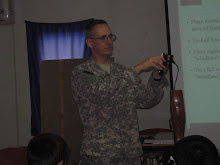
Two times a year the Afghan National Army hosts an 'annual' medical conference in Kabul. I am attending the fourth such event. The conference is more like a report from each of the Corps Surgeons and Regional Hospital commanders to the Surgeon General. The presentations were in powerpoint and were to be given in a rigid statistical format. English speaking mentors had earphones with translation available. A lot was lost in the translation though. It really makes you wonder how good the translation of speeches at the UN or similiar organizations are. A small mistranslation can so many times lead to a significant problem. Normally I do not wear weapons or body armor to medical conferences, but this was a unique conference.
The only American to speak was the Surgeon for the Afghan mentorship command. I would tell you the acronym, but I am not even sure I understand it. Besides it will change next week anyway. My point is that it was an Afghan run and operated conference. I can tell you that it is frightfully boring to listen to poor translations of speeches for several days in a row.
We also had a 3 hour breakout session of mentors. Most of us were US, but it was good to see our British and Canadian brethren there as well. There was some good information and a fairly clear priority of work for our organinzations. I wish I had been presented this information 3 months ago, since without any guidance from higher HQ our team has forged our own way. Some of this effort appears to be wasted since a countrywide solution to several problems is being enacted without our knowledge. As much as we jested about the Afghans squabbling amongst themselves about details, we are just as guilty of this charge. Nonetheless it was enlightening to hear the guidance and plans of our lead mentors.

The conference took place at the Afghan National Medical Hospital. The 400 bed ANA hospital is the crown jewel of the Afghan Military Medical system. Many of the team that I trained with at Ft Riley work to mentor the health providers at this facility. I believe the facility was originally built by the Russians during their time in Afghanistan. If so it is a testament to their building skills. It stands proudly as the largest and most intact of the buildings in the area. We had lunch atop the hospital every day. The veiw was a little hazy, as can be expected in Kabul, but dramatic nonetheless. The eight stories of stairs were also a challenge for those of us coming from closer to sea level elevations. It was interesting to hear about plans for cardiac catheterization labs when I know that they just recently have started using vital signs in their Emergency/Triage area. Like many of us I am sure that the newest best sounding equipment or procedure is more apetizing than taking time to master the basics. I am sure they could get as good information on the cardiac status of their patients by having them climb the stairs to the top floor. The Afghans as a institution also live so much in fear of addiction to narcotics that they are loathe to treat for pain. I thought you might enjoy the "No Spitting" sign located in the hospital.

Kabul itself is first and foremost a big city. I can envision a combination of Mexico city and Denver. I saw kites flying in the winds, dancing just as you might imagine they would. I saw tremendous traffic. But unlike many big cities there is still a cordial manner of the people you would not expect in a war zone. While I returned from the conference today an excited beautiful young child come up to me while I was in my scary looking body armor. She politely greeted me and put out her hand to shake mine.

I had the opportunity to see several friends here in Kabul. While over at another Camp I had the good fortune to meet up with a Brother Rat from VMI who is one of my oldest and best friends JPP. Thankfully we had time to catch up on our lives and families. While there are many who are complacent in their preparations in Kabul, he most certainly is not one of them. I also ran into another of my VMI BRs while walking around this camp. Then there was the bonus of seeing all of my Ft Riley classmates who are all doing quite well.
I am thankful for the opportunity to come here and experience a little bit of Kabul, but I admit I am ready to go back up North. I am after all a small town person and delightful as it can be Kabul is not a small town.

Friday, October 23, 2009

On the Road

Sorry no pictures, technical difficulties.

I started my trip to Kabul yesterday. We stayed on the German run base at Marmol, which has an airport. We had to wait until the next day for a flight into Kabul. Like all people who live on a small sized Camp we had to tour around the "big city" and observe all the ammenities available. The Norweigans have a nice PX and will actually accept dollars. There is also a small pizzeria as well. I think the Norweigan chow hall was the best part of the base though. Their food is catered through SODEXO. As further proof that it is the best chow hall on the camp, I noticed almost all of our Italian brethren eat there. The food was good. One difference between the US chowhalls and the Norweigan one is desert. There is no desert in the Norweigan chow hall. In US chow halls you can make an entire meal out of deserts.
I got to talk a little Italian to some Italian soldiers at Marmol which was both fun and humbling. It is amazing how much of a language you can forget in two years. They were nice guys and tolerated our invasion of their tent very well.
Another topic I have failed to adequately describe is that of money. For US forces in the northern region there is only one way to get cash. Nope, there are no ATMs. Nope, there is no finance office. The only way to get cash is when a team comes up to cash checks every month or two. Now don't get me wrong. There isn't a whole lot to spend money on at Camp Spann. There are the haircuts, the small PX for toiletries and such, the bazaar, and phone cards for calling home. That is the sum total of expenses at Spann. Since I am running short on cash I planned to get a little more cash while here in Kabul. Unfortunately I found out it will take another trip and some extra effort to accomplish.
The nice part about Kabul so far has been seeing most of the folks I trained with at Ft Riley. It is almost like a mini reunion. Thankfully everyone is well and still mentoring away.
Thank you USO, free wireless internet. Wow, this is the big city.

Tuesday, October 20, 2009

Double Header

Yesterday was a full day out and about in Mazar e Sharif. We visited both of the clinics we work with in the area. All told we spent about 3 hours travelling and 3 hours talking. As has become my rule, I did not exercise after wearing the Body Armor for 6 hours yesterday.

The biggest treat for me was to be the TC, or Truck Commander for our MRAP. You definitely get a different perspective on the 20 tons of rolling thunder that is an MRAP when you get a better field of view. I called in some checkpoints and got to help turn some of the systems on or off. It wasn't really that much like commanding, since the Sergeant next to me who has run this route about 100 times kept prompting me what to do next. Nonetheless I was glad for the opportunity. I think more than anything the soldiers who run this patrol let me sit up front because I do ride with them so often and inevitably end up in the back. I did get some low quality photos of a typical day on the streets of Mazar e Sharif to share.

We went past the Blue Mosque, which based of the dreams of a mullah in the 1100's, is the spot for the resting place of Ali Ibn Abi Talib, the cousin of the prophet Muhamed. The death of Ali was one of the major factors in the schism of sunni and shia muslims. A shrine was constructed on the spot. The name of the city Mazar e Sharif means "Noble Shrine". Najaf Iraq also claims to be the final resting place of Ali as well. The Blue Mosque, also known in Dari as the Rowza, is surrounded by some gardens, which my split second photo from a moving MRAP does not convey.

We got to meet with two groups of our mentees. We always have a laundry list of issues to discuss. We are making good progress on some building projects with the help of the Engineers in Kabul/HQ. We also plan to start a regional trauma course similiar to one that the US Army has used for years, Combat Lifesaver. The goal is to have the Afghans running this course completely on their own before my tour here is finished. Anything that is of benefit and self-sustainable is a very good thing.
The fields pictured are irrigated, which explains why there are any green plants present. The childrens excitement upon seeing a Coalition vehicle is almost universal. Perhaps in part due to the distribution of Shiryni, or sweets upon occasion.

Friday, October 16, 2009

Camel Ride شتر


Today was another fairly low key Jumaa. The day started like many others with PT. After a quick breakfast there were emails to answer and paperwork to do. The work day was rounded off with a long meeting.


Then there were the camels. Our MWR committee had them brought on camp for rides and photos for a donation. It was not that different than riding a horse. There was just more distance from me to the ground than on a horse. It was not as wobbly as an elephant. But it was not as messy as one either. I could not discern any overpowering camel smell. Perhaps the notorious Mazar e Shariff dust had clogged my nose thoroughly. Later I came by the area and noticed that someone had cleaned up after the camels. We can't have anything disgusting tainting our pristine gravel.


The end of the day I visited the Bazaar adjacent to camp. I did a little shopping again. I got to use a little of my Dari and found that I picked up more listening to casual conversation.

Thursday, October 15, 2009

PT


Every person in the US Armed Forces has an obligation to PT. According to Navy Regulation it should be done at least 3 times a week. PT is good for the body and certainly gives the mind a chance to process things as well. For those who may not be familiar with the abbreviation PT, it stands for Physical Training. A more common term is exercise.

When I am back at home I do a little exercise. I usually ride my bike to work two or three times a week. I will get out and run about once a week. In the summertime I play in the pool with the kids almost daily and that certainly counts as exercise if you have ever witnessed the event. But my exercise plan at home has been more about maintaining.

Here it is different. I work out a lot here at Spann. I started out with just a little every other day while at Ft Riley, but here I have become, well ......dependant on it. I will spend between 1 to 2 hours a day exercising these days. It is not only physical but mental health that pushes me to exercise more here. For one thing it fills the many hours I would normally spend with my family, sigh. The other is that it counters the rich foods that KBR serves in abundance here.
We have two small gyms. One is a tent and the other is a B-hut. Both have some cardio machines and weights. Running around our camp is not necessarily recommended for numerous reasons, not the least of which are the fist sized round rocks "ankle-breakers" which loosely serve as the surface for most of the camp. The gyms are rumored to be merging in another building soon. Thankfully the gyms are also open 24 hours. You can also usually find a cold bottle of water in them as well. Since the TV programming is not to my tastes 9 times out of 10, I have really enjoyed the ipod Tricia bought me. It has been a real blessing.
My big thing is the cardio machines. I like the elipticals. I have learned how to not fall or hurt myself on the treadmills after much effort. We have a nice rowing machine, which I enjoy. The stair steppers I only use when all of the other machines are full. My knees don't agree with them. The bike is fine as well. I don't really do weights either. I am not so far gone that I am ready to do races or marathons. Every time I have an appointment with a patient who is preparing for a marathon I always ask them 'How far is a marathon?' When they tell me 26.2 miles I respond- Really I thought it was the distance required to kill a Greek soldier- since that is what happened to the first Marathon runner.
I enjoy exercise here while I am deployed, but not that much.